

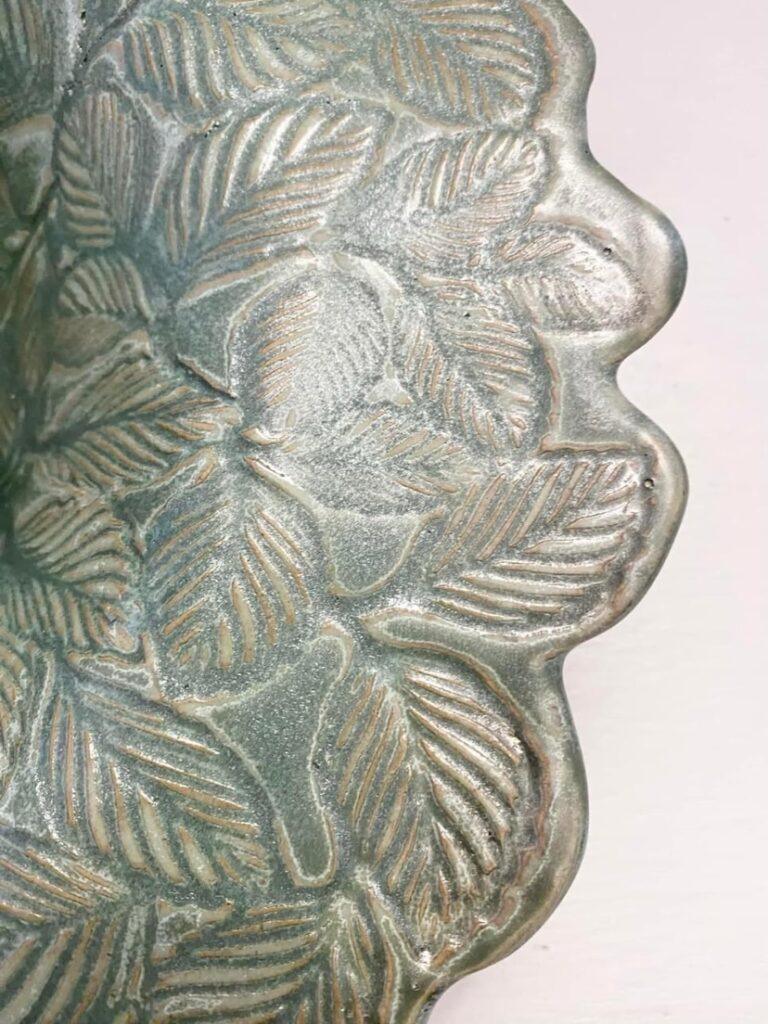
Mayco Ivy solo glazed plate by Therese Dellenlund
This piece is a great example of a “less is more” approach: one glaze, multiple coats, and a controlled firing/cooling schedule that helps the color develop evenly.
Glaze + firing details
- Clay body: White/beige stoneware (G&S clay)
- Glaze: Mayco Ivy – 3 coats
- Firing: Cone 6 with a 10-minute hold
- Cooling: Slow, controlled cool
Results and notes
How Ivy behaves on texture
Mayco Ivy settles into recesses and breaks slightly on raised areas, creating natural contrast. On this carved plate, the glaze gives a soft green tone with subtle variation, and the edges and leaf details stay crisp instead of getting muddy.
Why 3 coats work well here
With three coats, Ivy has enough thickness to become glossy and full in the deeper sections while still allowing the texture to show. If you apply fewer coats, the color can look lighter and less saturated -especially on lighter stoneware.
Why the hold + controlled cool matter
A short hold at Cone 6 helps even out the melt and smooth the surface. The slow controlled cool can improve overall clarity and depth, especially for glazes that develop better when the kiln doesn’t crash-cool too quickly.

- White/beige stoneware G&S clay
- MAYCO Ivy 3x
- Fired to Cone 6 with 10 min hold and slow controlled cool
Credit: Therese Dellenlund