

Snow over Ancient Copper and Satin Oribe
In this layered surface, Snow over Ancient Copper and Satin Oribe unfolds like a quiet meeting of elements – earth, mineral, and melt. Developed by Author: Isabelle Gallant, the combination is applied to Tucker’s MCS White porcelain, a clay body that allows subtle shifts in tone to remain clear and luminous after firing. At Cone 5–6, the glazes soften and move just enough to create gentle transitions, where each material keeps its identity while responding to the others.
The upper rim carries AMACO Ancient Copper, settling into a deep, iron-rich brown that feels grounded and steady. Across this band, AMACO Snow breaks and gathers, forming a pale, textured layer that suggests salt foam or mineral deposits left behind by receding water. Beneath, AMACO Satin Oribe stretches into cool blue-green, its satin surface catching light in a quiet, diffused way. Where these glazes meet, boundaries dissolve into soft edges, and the surface reads as a continuous landscape rather than separate applications.
Application plays a decisive role in the final result. Satin Oribe (3 coats) anchors the lower section, while Ancient Copper (3 coats) defines the rim and interior. A final overlap of Snow (3 coats) bridges both, encouraging interaction during the melt. Fired slowly to Cone 5–6 (approximately 2155–2160°F) with a short hold, the glazes settle into their characteristic layering – controlled, yet responsive. The finished surface carries both precision and variation, shaped equally by intention and by the kiln’s atmosphere.
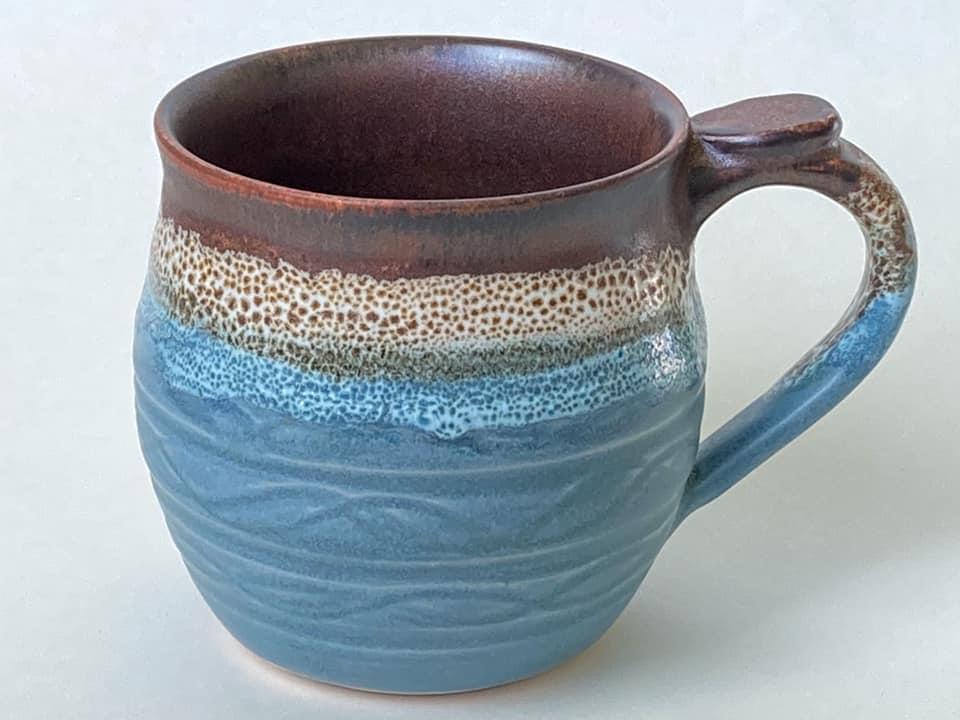
- Tucker’s MCS white porcelain
- AMACO Satin Oribe x3 on bottom
- AMACO Ancient Copper x3 top band
- AMACO Ancient Copper x3 inside
- AMACO Snow x3 overlapping both
- The program goes slow to 2155 F with a 30 minute hold, ending at about 2160 F (Celsius – goes slow to 1180°C with a 30-minute hold, ending at about 1182°C)
Credit: Isabelle Gallant